Interviews candidates take on their own time
How candidates answer
| Mode | Availability | How it works for the candidate |
|---|---|---|
| Text | Available now, the default | One question at a time. Answers save as the candidate goes, so they can stop and come back. |
| Voice | From release 1.0 (target: Q4 2027), optional | Recorded in the browser on a phone or computer, after a device check and a practice question that is not stored. |
| Video | From release 1.0 (target: Q4 2027), optional and never required | Available when an employer wants it. Candidates can always answer by text or voice instead, and video is never analyzed for faces or expressions. |
Until then, candidates answer in writing. The demo shows voice and video answers with prepared transcripts. Recorded answers will allow one re-record per question. Candidates read their own transcript and can correct it before they submit.
Consent and accommodation come first
- What is recorded, who can see it, and that recordings are kept in Canada.
- That transcripts are evaluated with AI services in the United States, after names and contact details are removed.
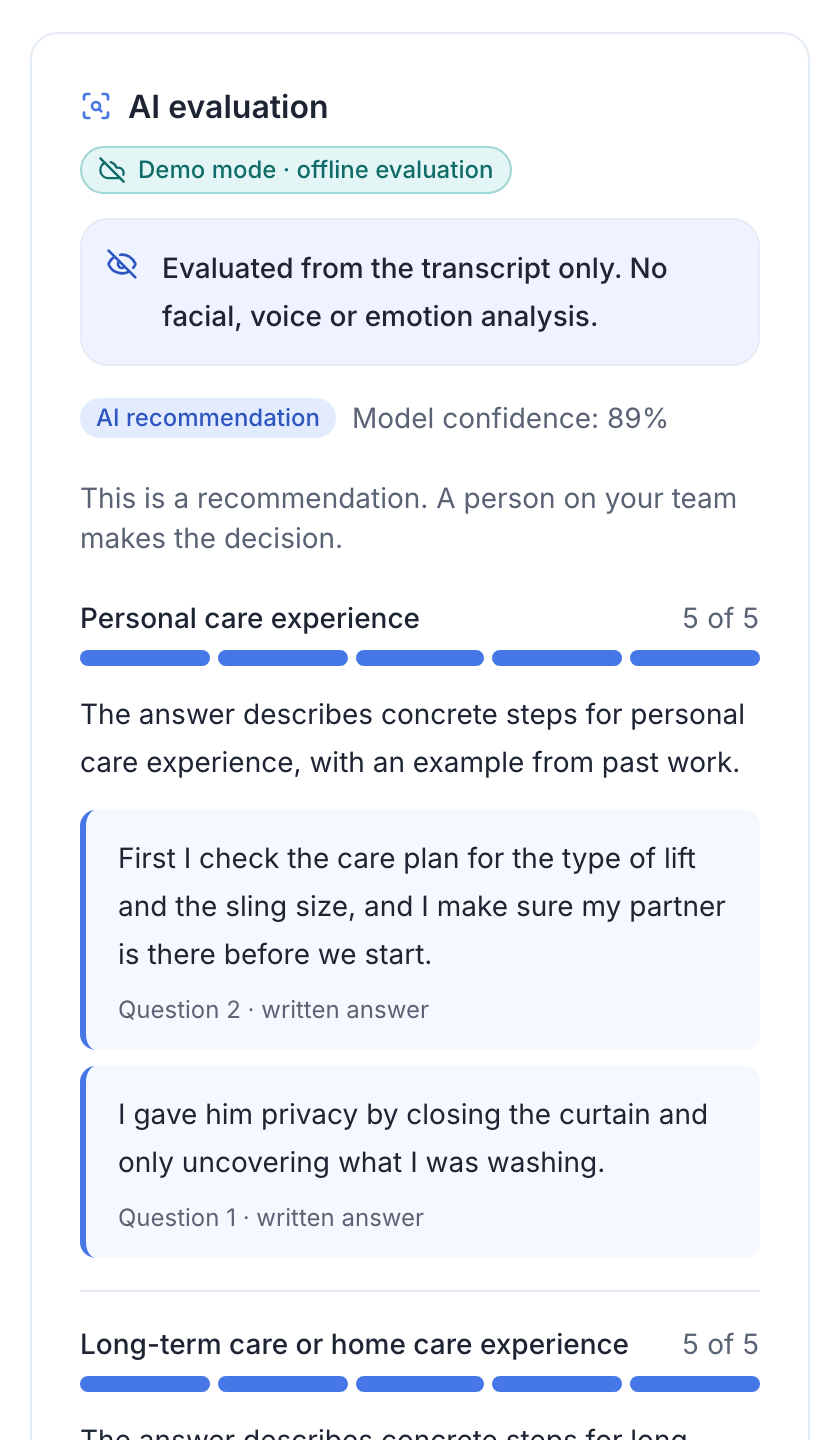
- That there is no analysis of faces, tone of voice, emotions or personality.
- That recordings are deleted 90 days after the interview, unless a legal hold applies.
Candidates can ask for extra time, answer by text only, or have an interview with a person instead. Requests go to the recruiter and are tracked like any other task.
Evaluated from the transcript
- A score from 0 to 5 for each criterion in the approved rubric, with a one-sentence reason.
- Every quote is checked to appear word for word in the transcript.
- Limitations are stated: a short answer or a missing topic is reported, not guessed at.
- The recruiter decides with their own reason. When the interview completes, the 45-day outcome clock starts.
Scheduling the next conversation
Integrations behind interviews
| Integration | State |
|---|---|
| Interview transcription | Simulated Planned for release 1.0, target Q4 2027 |
| Google Calendar | Planned Waiting on: Google’s verification of the app’s calendar permission, not requested yet. It needs the company domain, verified and carrying the privacy policy, which is not in place yet. Planned for release 1.0, target Q4 2027 |
| Microsoft Outlook calendar | Planned Waiting on: Microsoft publisher verification for the app, not requested yet and tied to the company domain, then each customer administrator’s consent. Planned for release 1.0, target Q4 2027 |
States as of October 9, 2026. We check them again by November 30, 2026.